Spirulina: The Toxin Scare Is About a Different Algae
Spirulina is a blue-green microbe grown in ponds, then dried into powder or tablets. The toxin scare you may have read about comes from wild algae, not spirulina. Trials found lower cholesterol and slightly lower blood pressure. It is not a treatment. Our pick: Zazzee Organic Spirulina Powder, $0.12 per 3 g.
By Erin Rose Updated October 18, 2026 How we score
Costs are brand prices per 3 g (October 18, 2026).
What to buy
Zazzee Organic Spirulina Powder is our pick. It costs the least per 3 g of any spirulina we checked, at the brand’s own price, and Zazzee says an independent lab tests it for microcystin (an algae toxin) and heavy metals.

Zazzee Organic Spirulina Powder
$0.12 per 3 g
Where to go next
- Best spirulina: every product we scored, ranked.
- Spirulina dosage guide: how much to take.
- Is your spirulina clean?: toxins and testing.
What spirulina does
Spirulina (Arthrospira) is a microbe that grows in warm water. Dried, it is mostly protein (Karkos 2011). It is a whole food, not an extract. The trials are small and measured blood numbers.
| Goal | Evidence | What trials found |
|---|---|---|
| Cholesterol | Some | A review of 20 studies (1,076 people) and an earlier review found lower total cholesterol, LDL and triglycerides. |
| Blood pressure | Some | A 2025 review found blood pressure about 4 points lower on top and 3 points lower on the bottom. An earlier review agreed. |
| Blood sugar | Small | A review of 8 studies in people with type 2 diabetes found lower fasting blood sugar, but no change in HbA1c, the 3-month measure. |
| Hay fever | One trial | One trial at 2 g a day found milder nose symptoms than a dummy pill. It was run at a single clinic. |
| Energy and exercise | Mixed | One trial in 9 men found they lasted about 40 seconds longer in a hard sprint after a 2-hour run; a trial in 17 cyclists found no change in performance. |
| Heavy-metal detox | No trials | No trial of spirulina alone. One trial of spirulina extract plus zinc in people with arsenic poisoning found more arsenic cleared. |
How long does spirulina take to work?
No trial gives a set time. The blood pressure trials ran 2 to 12 weeks, and blood pressure dropped more in trials longer than 8 weeks (Shiri 2025). Give it at least 2 months before judging.
How much to take
Most labels say about 3 g a day. Studies used 1 to 8 g a day. See the dosage guide.
Is spirulina safe?
For most people, yes. Side effects are usually mild: loose stools, bloating or a headache (LactMed). Check these:
- Autoimmune disease: avoid it. Spirulina stimulates the immune system, and doctors have reported 5 cases of autoimmune disease starting or flaring in people taking it (de Carvalho 2025).
- PKU: count it. Spirulina is mostly protein, so it adds phenylalanine to your diet.
- Diabetes medicine: ask your doctor. Spirulina lowered fasting blood sugar in trials, so it could add to your medicine.
- Blood thinners: ask your doctor. A compound from spirulina slowed clotting in a lab test (Hayakawa 1996). It has not been tested in people.
- Pregnant or breastfeeding: ask your doctor. There is no data on spirulina in breast milk (LactMed).
Toxins: when a lab tested 13 algae supplements, the toxin microcystin turned up only in the wild blue-green algae (AFA) products, not in spirulina (Heussner 2012). Poorly grown products can still pick up toxins or heavy metals (LactMed), so a stated test or a known farm helps. See which brands state their testing.
Want to know where yours was grown? Nutrex Hawaii says its spirulina is grown and made in Kona, Hawaii.
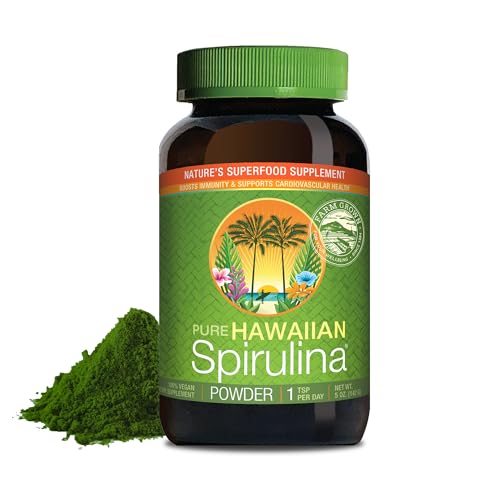
Nutrex Hawaii Pure Hawaiian Spirulina Powder
Grown in Kona, Hawaii · $0.31 per 3 g
Questions people ask
Does spirulina give you more energy?
Probably not in a way you would notice. In two exercise trials at 6 g a day, one found a small gain at the end of a long run and the other found none (Kalafati 2010; Ali 2024). No trial measured everyday energy.
Does spirulina remove heavy metals from your body?
Not for most people. The one trial gave spirulina extract plus zinc to people with arsenic poisoning from their water, so it does not apply to spirulina alone (Misbahuddin 2006). A poorly made product can add metals instead, which is why a stated test matters.
Sources
- Karkos PD, et al. “Spirulina in clinical practice: evidence-based human applications.” Evid Based Complement Alternat Med. 2011. PubMed 18955364
- Rahnama I, et al. “The effect of Spirulina supplementation on lipid profile: GRADE-assessed systematic review and dose-response meta-analysis of data from randomized controlled trials.” Pharmacol Res. 2023. PubMed 37263369
- Serban MC, et al. “A systematic review and meta-analysis of the impact of Spirulina supplementation on plasma lipid concentrations.” Clin Nutr. 2016. PubMed 26433766
- Shiri H, et al. “The Effect of Spirulina Supplementation on Blood Pressure in Adults: A GRADE-Assessed Systematic Review and Meta-Analysis of Randomized Clinical Trials.” Phytother Res. 2025. PubMed 39529406
- Machowiec P, et al. “Effect of Spirulina Supplementation on Systolic and Diastolic Blood Pressure: Systematic Review and Meta-Analysis of RCTs.” Nutrients. 2021. PubMed 34578932
- Hatami E, et al. “Effect of spirulina on glycemic control: a systematic review and meta-analysis.” J Diabetes Metab Disord. 2021. PubMed 34178867
- Cingi C, et al. “The effects of spirulina on allergic rhinitis.” Eur Arch Otorhinolaryngol. 2008. PubMed 18343939
- Kalafati M, et al. “Ergogenic and antioxidant effects of spirulina supplementation in humans.” Med Sci Sports Exerc. 2010. PubMed 20010119
- Ali Y, et al. “Fourteen-Days Spirulina Supplementation Increases Hemoglobin, but Does Not Provide Ergogenic Benefit in Recreationally Active Cyclists.” J Diet Suppl. 2024. PubMed 37807529
- Misbahuddin M, et al. “Efficacy of spirulina extract plus zinc in patients of chronic arsenic poisoning: a randomized placebo-controlled study.” Clin Toxicol. 2006. PubMed 16615668
- de Carvalho JF, et al. “Spirulina ingestion and autoimmune disease onset or flare.” Letter. Adv Rheumatol. 2025. PubMed 40087772
- Hayakawa Y, et al. “Heparin cofactor II-dependent antithrombin activity of calcium spirulan.” Blood Coagul Fibrinolysis. 1996. PubMed 8874866
- Heussner AH, et al. “Toxin content and cytotoxicity of algal dietary supplements.” Toxicol Appl Pharmacol. 2012. PubMed 23064102
- National Institute of Child Health and Human Development. “Spirulina.” Drugs and Lactation Database (LactMed). PubMed 30000909