Vitamin D Side Effects: Too Much, Toxicity and the Signs
At up to 4,000 IU a day, most people get no side effects from vitamin D. Too much over months raises blood calcium, which causes nausea, vomiting, constipation, thirst, frequent urination, weakness and confusion. Poisoning is rare. It almost always comes from very large doses, often a prescription or a mislabeled product.
By Erin Rose Updated October 20, 2026 How we score
Warning signs of too much vitamin D
Too much vitamin D shows up as high blood calcium. Watch for:
- Nausea, vomiting or no appetite
- Constipation or belly pain
- Being very thirsty and peeing a lot
- Muscle weakness or confusion
If you take a high dose and have vomiting, confusion or severe weakness, stop the vitamin D and call a doctor today. Ask for a blood calcium test. These signs have many other causes, so on a normal dose of 1,000 or 2,000 IU, vitamin D is an unlikely reason.
A dose that stays under the limit
Well under the limit: 2,000 IU
Half the 4,000 IU daily limit, and more than the 600 to 800 IU adults need. NatureWise D3 2000 IU is on NSF/ANSI 173, which checks that the bottle holds the dose on the label.

NatureWise Vitamin D3 2000 IU in Olive Oil
$0.04 a day · 2,000 IU · NSF/ANSI 173
Cutting back from a high dose: 1,000 IU
If you have been taking 5,000 IU or more and want to come down, 1,000 IU still covers the daily need. NatureWise D3 1000 IU is a small softgel. It is on NSF/ANSI 173, a list that checks the bottle holds what the label says.
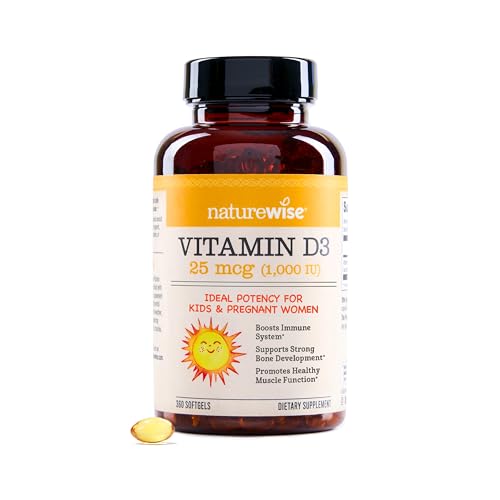
NatureWise Vitamin D3 1000 IU in Olive Oil
$0.03 a day · 1,000 IU
How much vitamin D is too much
| Dose | What was found |
|---|---|
| Up to 4,000 IU a day | The adult upper limit (NIH). Side effects are rare. |
| 4,000 IU a day for 3 years | Slightly high blood calcium in 3% of people (0% on 400 IU); all cleared on a repeat test. Wrist bone density fell more than on 400 IU. |
| 10,000 IU a day for 3 years | Slightly high blood calcium in 9%, and wrist bone density fell the most. |
| 40,000 IU a day or more, for months | The doses in every poisoning case with a known dose, in a 1999 review. |
| 500,000 IU once a year | More falls and fractures in women 70 and older. |
Sources: the 3-year rows are one trial of 373 healthy adults aged 55 to 70 (Billington 2020), with bone density measured in 311 of them (Burt 2019). Extra calcium in the urine was also more common at higher doses: 17% on 400 IU, 22% on 4,000 IU and 31% on 10,000 IU. The 40,000 IU row is a review of published cases (Vieth 1999), and the yearly dose is a trial of 2,256 women (Sanders 2010). Lower doses are not risk-free for everyone: the NIH says even intakes under the limit might cause problems over time.
Can too much vitamin D cause high calcium?
Yes, and that is the main harm. Vitamin D helps your gut absorb calcium. At very high levels it pushes absorption past what the body can control, and blood calcium rises (Tebben 2016). Doctors call it vitamin D toxicity when a 25(OH)D level (the standard vitamin D blood test) is above 150 ng/mL (375 nmol/L) and blood calcium is high, usually above 11.1 mg/dL against a normal 8.4 to 10.2 (NIH; Marcinowska-Suchowierska 2018).
A high test result alone is not poisoning. Over 10 years in one US county, 1,714 people had a test above 50 ng/mL (out of 20,308 tests), but only 4 had high calcium linked to it, and 1 had toxicity (Dudenkov 2015). If your level is high, ask your doctor about a lower dose and a retest.
Vitamin D warnings: who should ask a doctor first
Ask before taking vitamin D if any of these apply to you:
- Sarcoidosis, tuberculosis or some lymphomas. These can turn vitamin D into its active form outside the body’s normal control, so even a normal dose can raise calcium (Tebben 2016).
- An overactive parathyroid gland, kidney disease or past calcium kidney stones. Your body already has trouble controlling calcium.
- Thiazide water pills. The NIH flags hydrochlorothiazide and similar drugs with vitamin D as a risk for high calcium, mainly in older adults. In a 3-month trial with up to 4,000 IU a day, users ended with slightly higher calcium than non-users (Chandler 2014).
- Digoxin. High calcium makes this heart drug more likely to cause harm (FDA label).
- Calcium pills plus vitamin D. In the Women’s Health Initiative, 400 IU plus 1,000 mg of calcium a day for 7 years raised the risk of kidney stones by 17% (Jackson 2006). In long-term trials of vitamin D without added calcium, kidney stones did not rise (Malihi 2016).
- Children. Their limits are lower: 1,000 IU a day under 6 months, 2,500 IU at ages 1 to 3, and 3,000 IU at ages 4 to 8 (NIH). Ask a pediatrician before giving adult products.
About 1 in 6 labels tell you to take more than the limit
152 of the 905 vitamin D labels with a daily direction tell you to take more than 4,000 IU a day (17%). We read the 936 vitamin D labels in the NIH label database that list a dose, on September 16, 2026. The typical label directs 1,000 IU a day, but one in ten directs 5,000 IU or more.
Most poisoning cases come from very high doses taken for months, usually prescribed (Kaur 2015), or from products made or labeled wrong (Araki 2011). Taking more than one product with vitamin D can also push your total over the limit. It is in multivitamins, calcium pills, prenatals and fish oil blends, so add up every label before you add another bottle. The 1,000 vs 5,000 IU guide helps you pick a dose, and the 25(OH)D test guide explains your blood result.
Questions people ask
What are the symptoms of too much vitamin D?
The symptoms come from high blood calcium: feeling sick, throwing up, poor appetite, constipation, thirst, peeing a lot, muscle weakness and confusion. Very high calcium over time can lead to kidney stones (NIH; Marcinowska-Suchowierska 2018). These signs have other causes too, so only a blood calcium test can tell.
How much vitamin D is too much?
For adults, the daily upper limit is 4,000 IU (100 mcg) from all sources. Experts say signs of poisoning are unlikely below 10,000 IU a day (NIH). The NIH also notes that even intakes under the limit might cause problems over time, and a few people get high calcium on usual doses (Marcinowska-Suchowierska 2018).
What are the side effects of 50,000 IU (1,250 mcg) of vitamin D?
1,250 mcg is 50,000 IU, more than 12 times the daily limit, and some bottles sell at this strength without a prescription. Taken every day for months, it is the kind of dose behind vitamin D poisoning. Big doses spaced out have risks too: older adults given 60,000 IU a month fell more often than those given 24,000 IU (Bischoff-Ferrari 2016), and the Endocrine Society prefers a daily dose (Demay 2024). Take it only as a doctor directs, with blood tests.
What are the side effects of 1,000 mg of vitamin D?
Vitamin D is not sold in milligrams, so a “1,000” label almost always means 1,000 IU (25 mcg). That is well under the 4,000 IU limit. If a label says 1,000 mcg, that is 40,000 IU, ten times the limit; take it only as a doctor directs. The IU to mcg chart converts any label.
How long do vitamin D side effects last?
Vitamin D is stored in the body, so after a big overdose the blood level falls slowly. In two people poisoned by mislabeled US supplements, calcium and symptoms returned to normal once their level fell below 400 ng/mL, but the level took about a year to fully normalize (Araki 2011). See a doctor rather than waiting it out.
Can you get too much vitamin D from the sun?
No. Your skin limits how much vitamin D it makes from sunlight, so experts do not think sun exposure causes vitamin D poisoning (NIH). The NIH notes one exception: frequent tanning-bed use can push blood levels too high.
What blood level counts as vitamin D toxicity?
Toxicity means a 25(OH)D level above 150 ng/mL (375 nmol/L) along with high blood calcium (NIH; Marcinowska-Suchowierska 2018). The NIH suggests staying below about 50 to 60 ng/mL (125 to 150 nmol/L).
Does vitamin D interact with medicines?
Yes. Water pills called thiazides and the heart drug digoxin can make high calcium more likely or more dangerous. Steroids like prednisone and the weight-loss drug orlistat can lower your vitamin D (NIH). Tell your pharmacist about every supplement you take.
Is 5,000 IU of vitamin D a day too much?
It is above the 4,000 IU limit. In a 3-year trial, 4,000 IU a day caused slightly high blood calcium in 3% of people and lowered wrist bone density more than 400 IU did (Billington 2020; Burt 2019). Take 5,000 IU only if a doctor set the dose and checks your level.
More on vitamin D
Vitamin D dosage guide, best vitamin D supplement, vitamin D with or without K2, vitamin D for seniors and vitamin D for women.
Sources
- NIH Office of Dietary Supplements, “Vitamin D: Fact Sheet for Health Professionals” (upper limit, toxicity, sun, medicines). ods.od.nih.gov
- Billington EO, et al. “Safety of high-dose vitamin D supplementation: secondary analysis of a randomized controlled trial.” J Clin Endocrinol Metab. 2020. PubMed 31746327
- Burt LA, et al. “Effect of high-dose vitamin D supplementation on volumetric bone density and bone strength: a randomized clinical trial.” JAMA. 2019. PubMed 31454046
- Vieth R. “Vitamin D supplementation, 25-hydroxyvitamin D concentrations, and safety.” Am J Clin Nutr. 1999. PubMed 10232622
- Sanders KM, et al. “Annual high-dose oral vitamin D and falls and fractures in older women: a randomized controlled trial.” JAMA. 2010. PubMed 20460620
- Tebben PJ, et al. “Vitamin D-mediated hypercalcemia: mechanisms, diagnosis, and treatment.” Endocr Rev. 2016. PubMed 27588937
- Marcinowska-Suchowierska E, et al. “Vitamin D toxicity: a clinical perspective.” Front Endocrinol. 2018. PubMed 30294301
- Dudenkov DV, et al. “Changing incidence of serum 25-hydroxyvitamin D values above 50 ng/mL: a 10-year population-based study.” Mayo Clin Proc. 2015. PubMed 25939935
- Araki T, et al. “Vitamin D intoxication with severe hypercalcemia due to manufacturing and labeling errors of two dietary supplements made in the United States.” J Clin Endocrinol Metab. 2011. PubMed 21917864
- Chandler PD, et al. “Risk of hypercalcemia in blacks taking hydrochlorothiazide and vitamin D.” Am J Med. 2014. PubMed 24657333
- Jackson RD, et al. “Calcium plus vitamin D supplementation and the risk of fractures.” N Engl J Med. 2006. PubMed 16481635
- Kaur P, et al. “Vitamin D toxicity resulting from overzealous correction of vitamin D deficiency.” Clin Endocrinol. 2015. PubMed 26053339
- Malihi Z, et al. “Hypercalcemia, hypercalciuria, and kidney stones in long-term studies of vitamin D supplementation: a systematic review and meta-analysis.” Am J Clin Nutr. 2016. PubMed 27604776
- Bischoff-Ferrari HA, et al. “Monthly high-dose vitamin D treatment for the prevention of functional decline: a randomized clinical trial.” JAMA Intern Med. 2016. PubMed 26747333
- Demay MB, et al. “Vitamin D for the prevention of disease: an Endocrine Society clinical practice guideline.” J Clin Endocrinol Metab. 2024. PubMed 38828931
- Digoxin prescribing information (FDA label), hypercalcemia among the conditions that raise the risk of digoxin toxicity. DailyMed
- NIH Office of Dietary Supplements, Dietary Supplement Label Database (vitamin D labels read September 16, 2026). dsld.od.nih.gov