How Much Vitamin B6 Per Day? 1.3 to 1.7 mg, and Stay Well Under 100 mg
Adults need 1.3 mg of vitamin B6 a day, rising to 1.5 mg (women) or 1.7 mg (men) after 50. Most people get it from food (NIH). If you take a pill, a 25 mg dose is well under the US limit of 100 mg a day, but above Europe’s 12 mg limit. One review says more than 50 mg a day for a long time may be harmful.
Best vitamin B6 to hit your dose
- Buy on Amazon for Nutricost Vitamin B6 25 mg
Our pick: 25 mg in 1 capsule
Nutricost Vitamin B6 25 mg $0.06 a day at Nutricost’s list price (1 capsule)
25 mg of B6 as pyridoxine HCl, the most common form in supplements (NIH), in one capsule a day. That is a quarter of the US limit. A 240-capsule bottle lasts about eight months. It is not on a public testing list.
- Check price on Amazon for Solgar Vitamin B6 25 mg
You want a smaller bottle
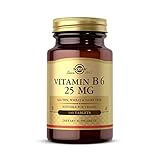
Solgar Vitamin B6 25 mg
The same 25 mg of pyridoxine HCl in one tablet, 100 tablets a bottle. It is not on a public testing list.
- Check price on Amazon for Thorne Pyridoxal 5’-Phosphate
You want P5P on a testing list
Thorne Pyridoxal 5’-Phosphate $0.31 a day at Thorne’s list price (1 capsule)
33.8 mg of B6 as P5P (pyridoxal 5’-phosphate) in one capsule. It is on NSF’s certified list. It is a bigger dose than 25 mg. The label allows up to 3 capsules a day (about 101 mg), which is over the US limit of 100 mg. One capsule a day stays well under it.


Cost a day is each brand’s own store price for one bottle, read October 27, 2026. Solgar’s store does not show a price.
Stop and see a doctor if you feel tingling or numbness in your hands or feet. Too much B6 over a long time can damage nerves; symptoms usually get better if you stop the pills as soon as they start (NIH). Check your other pills too: multivitamins and B-complex products can also hold B6. B6 and nerve damage.
A summary of NIH guidance and published research, not medical advice. Ask your doctor first if you are pregnant or take seizure medicine.
How much vitamin B6 you need
The Recommended Dietary Allowance (RDA) is 1.3 mg a day for adults 19 to 50. After 50 it is 1.7 mg for men and 1.5 mg for women (NIH). Labels use 1.7 mg as the Daily Value for “% DV.”
Most people in the US get enough from food. On average, women get about 1.5 mg a day and men about 2 mg (NIH). Low B6 levels are more common in people with kidney disease, celiac disease, Crohn’s disease, ulcerative colitis, rheumatoid arthritis or alcohol dependence (NIH).
| Age | Men | Women | Pregnant | Nursing |
|---|---|---|---|---|
| 1–3 years | 0.5 | 0.5 | – | – |
| 4–8 years | 0.6 | 0.6 | – | – |
| 9–13 years | 1.0 | 1.0 | – | – |
| 14–18 years | 1.3 | 1.2 | 1.9 | 2.0 |
| 19–50 years | 1.3 | 1.3 | 1.9 | 2.0 |
| 51+ years | 1.7 | 1.5 | – | – |
Babies: 0.1 mg (0–6 months), 0.3 mg (7–12 months).
The upper limit: 100 mg in the US, 12 mg in Europe
B6 is not a “more is better” vitamin. Taking 1 to 6 grams a day for 12 to 40 months can cause severe damage to the nerves that carry feeling, so people lose control of their movements (NIH). It usually stops if you stop the pills as soon as symptoms start (NIH). People report feeling better after stopping (Muhamad 2023).
To set the US limit, experts looked at studies where people took an average of 200 mg a day for up to 5 years with no nerve damage. They cut that in half to get 100 mg a day for adults, counting food and supplements together (NIH). They also noted several reports of nerve damage below 500 mg a day. Food B6 has not been shown to cause harm (NIH).
Other experts are stricter. In 2023, Europe’s food safety agency (EFSA) set its limit at 12 mg a day for all adults, including during pregnancy (NIH). A 2014 review said taking more than 50 mg a day for a long time may be harmful and should be discouraged (Ghavanini 2014). So treat 100 mg as a ceiling to stay well under, not a target. The full story is on our B6 neuropathy and upper limit page.
| Age | Upper limit |
|---|---|
| 1–3 years | 30 mg |
| 4–8 years | 40 mg |
| 9–13 years | 60 mg |
| 14–18 years | 80 mg |
| 19+ years | 100 mg |
The same limits apply during pregnancy and nursing. No limit is set for babies; their B6 should come only from breast milk, formula and food (NIH). The limits do not apply to people a doctor is treating with B6.
Dose checker: how does your B6 compare?
Enter the B6 in one serving (the vitamin B6 line on the Supplement Facts panel) and how many servings you take a day. Add any B6 from a multivitamin or B-complex too. For P5P, use the vitamin B6 line, not the P5P weight.
Read the B6 number, not the P5P number
Most B6 supplements use pyridoxine HCl. Some use P5P (pyridoxal 5’-phosphate), one of the forms your body puts to work (NIH). P5P weighs more than the B6 it holds. Some “P5P 50 mg” products hold about 34 mg of B6; others hold 50 mg. Thorne’s capsule, for example, lists 33.8 mg of B6 as P5P. Always use the vitamin B6 line on the Supplement Facts panel. The limit counts the B6 itself, so a product with 100 mg of B6 as P5P is still at the limit.
P5P is often sold as gentler. NIH says the body absorbs the supplement forms about the same. Choose the dose first, then the form.
Should you take a B6 pill?
- Most people do not need a B6 pill. Food covers the RDA for most US adults (NIH).
- If you take one, a 25 mg pill is plenty. That is many times the RDA and a quarter of the US limit. See the B6 products ranked by dose.
- Do not make 100 mg a daily habit. It is the US limit itself, with no room to spare for years of use.
- Add up every source. A multivitamin or B-complex can hold B6 too.
What B6 pills hold: many sit at the limit
Of the 12 vitamin B6 products we track, only 2 hold 25 mg or less. 5 hold 100 mg a serving, the US limit. The rest hold about 33 to 50 mg. Both 25 mg products are in the list above. Every product is ranked by dose on best vitamin B6.
Where you get B6 from food
B6 is in many foods. The richest are fish, beef liver, potatoes and other starchy vegetables, and fruit other than citrus (NIH). Many breakfast cereals add it too.
| Food | Vitamin B6 |
|---|---|
| Chickpeas, canned, 1 cup | 1.1 mg |
| Beef liver, pan fried, 3 ounces | 0.9 mg |
| Tuna, yellowfin, cooked, 3 ounces | 0.9 mg |
| Salmon, sockeye, cooked, 3 ounces | 0.6 mg |
| Chicken breast, roasted, 3 ounces | 0.5 mg |
| Potatoes, boiled, 1 cup | 0.4 mg |
| Banana, 1 medium | 0.4 mg |
| Turkey, roasted, 3 ounces | 0.4 mg |
A cup of chickpeas gives you most of an adult’s 1.3 mg. A piece of chicken and a banana give you about two-thirds.
Ask your doctor first
- Pregnancy. B6 is used for morning sickness: ACOG suggests 10 to 25 mg three or four times a day. NIH says to ask a doctor before taking B6 while pregnant, because those doses can come close to the limit.
- Seizure medicines. Some (valproic acid, carbamazepine, phenytoin) lower B6 levels. High-dose B6 (200 mg a day) may lower blood levels of phenytoin and phenobarbital (NIH).
- Other medicines. Theophylline (for asthma and lung disease) and the TB antibiotic cycloserine also affect B6 (NIH). Ask your doctor or pharmacist about B6 if you take these.
- Nerve symptoms. If you already have numbness or tingling, ask a doctor before taking B6. Stop the pills if numbness or tingling starts or gets worse.
Frequently asked questions
How much vitamin B6 should I take per day?
Adults need 1.3 mg a day up to age 50. After 50, men need 1.7 mg and women 1.5 mg (NIH). Most people in the US get that from food.
What is the upper limit for vitamin B6?
100 mg a day for adults in the US, from food and supplements together (NIH). Teens 14 to 18: 80 mg. Europe’s food safety agency set 12 mg a day for adults in 2023 (NIH). One review says more than 50 mg a day for a long time may be harmful (Ghavanini 2014). Treat 100 mg as a ceiling, not a target.
Is a 100 mg B6 supplement too much?
Yes, for daily use. 100 mg is the US limit by itself, so the B6 from food and any multivitamin puts you over it. It is also twice the 50 mg level one review warns about. A 25 mg pill gives you far more than you need and stays well under the limit. Read the B6 line on the Supplement Facts panel.
Does the form (pyridoxine vs P5P) change the dose?
The limit counts the B6 itself, whatever the form. P5P is heavier than the B6 inside it. Some “P5P 50 mg” products have about 34 mg of B6 and others have 50 mg, so go by the vitamin B6 line on the label. NIH says the body absorbs the supplement forms about the same. Pick the dose first, then the form.
Does vitamin B6 have side effects, and who should be cautious?
Too much B6 for a long time can damage the nerves that carry feeling, so people lose control of their movements (NIH). It is reported mostly at 1 to 6 grams a day for a year or more, and symptoms usually get better if the pills stop as soon as they start (NIH). If you feel tingling or numbness, stop and see a doctor. Ask your doctor first if you are pregnant or take seizure medicine.
Bottom line: most people get enough B6 from food. If you want a pill, our pick is Nutricost Vitamin B6 25 mg, one capsule a day.
Related guides
- Vitamin B6 neuropathy and the upper limit: why the 100 mg ceiling exists
- Best vitamin B6: every product ranked by dose, lowest first
- Vitamin B6 guide: P5P vs pyridoxine
Sources
- NIH Office of Dietary Supplements. Vitamin B6 fact sheet for health professionals (updated June 16, 2023; read October 27, 2026). RDAs (Table 1), foods (Table 2), upper limits (Table 3), Daily Value, intakes, forms and absorption, nerve damage, EFSA 2023 limit, pregnancy, medicine interactions.
- Ghavanini AA, Kimpinski K. “Revisiting the evidence for neuropathy caused by pyridoxine deficiency and excess.” J Clin Neuromuscul Dis. 2014. PMID: 25137514
- Muhamad R, et al. “The Role of Vitamin B6 in Peripheral Neuropathy: A Systematic Review.” Nutrients. 2023. PMID: 37447150
- EFSA NDA Panel. Scientific opinion on the tolerable upper intake level for vitamin B6. EFSA Journal 2023;21(5):8006 (as summarized by NIH).
- Product amounts: each product’s Supplement Facts label; full dataset at /vitamin-b6/cost-by-brand.json (CC BY 4.0). Store prices: nutricost.com and thorne.com, read October 27, 2026. Testing status: NSF certified products and USP Verified lists, searched for all three products.
This page is for information. It is not medical advice.