Supplement doses keep climbing. The US sets no limit.
By Erin Rose · Verified Supplement Data · October 13, 2026 · How we did this · Data
Supplement labels tell people to take more than they used to. We read the Supplement Facts panel on 4,609 labels filed with the NIH since 2010.
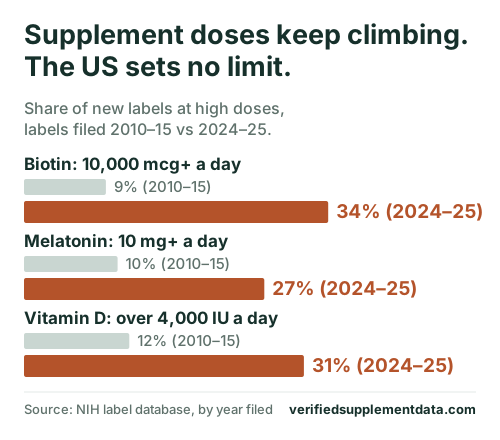
A third of new biotin labels now call for 10,000 mcg a day. Adults need about 30. Nearly a third of new vitamin D labels go past the safe daily limit, up from about 1 in 9. One in four new melatonin labels is 10 mg or more. The vitamin B6 that tops Amazon’s search results has 8 times what Europe calls safe.
None of this breaks a rule. A 1976 law bars the FDA from capping vitamin and mineral doses.
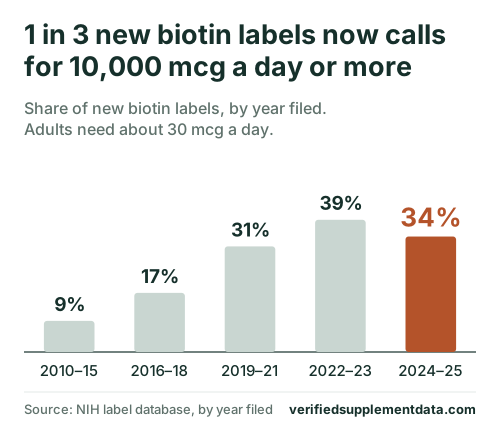
A third of new biotin labels call for 330 times what you need
Biotin is sold for hair, skin and nails. Adults need about 30 mcg a day. In 2010–15, 9% of new biotin labels called for 10,000 mcg or more. In 2024–25 it was 34%.
This is not only new brands. Among brands that filed labels in both periods, the share at 10,000 mcg or more went from 6% to 28%.
The NIH has set no upper limit for biotin. The risk is a wrong lab result. In 2017 the FDA warned that high-dose biotin can throw off some blood tests, including the troponin test doctors use to spot a heart attack. The FDA reported that one patient taking high levels of biotin died after that test came back falsely low [3]. Labels kept climbing after the warning.
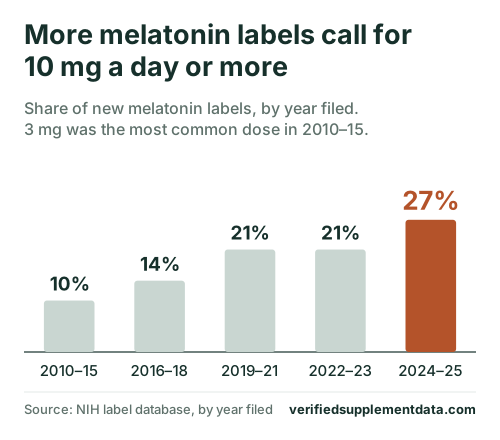
1 in 4 new melatonin labels is now 10 mg or more
In 2010–15, the most common dose on a new melatonin label was 3 mg. Only 10% of labels called for 10 mg or more. In 2024–25, 27% did. Half of new labels are now above 3 mg. Some products are sold as 60 mg.
Children are getting into it. Calls to poison centers about kids swallowing melatonin rose 530% from 2012 to 2021, the CDC found [4]. Of the 27,795 children who needed care at a health facility, 14.7% were hospitalized. Two died. Gummies add a second problem. A 2023 JAMA study found 22 of 25 melatonin gummies held a different amount than the label said, from 74% to 347% of it [5].
Nearly 1 in 3 new vitamin D labels goes past the safe daily limit
The NIH says adults should not take more than 4,000 IU of vitamin D a day. In 2010–15, 12% of new labels went past that. In 2024–25, 31% did. The typical new label went from 800 IU to 2,000 IU, and 50,000 IU capsules are still sold.
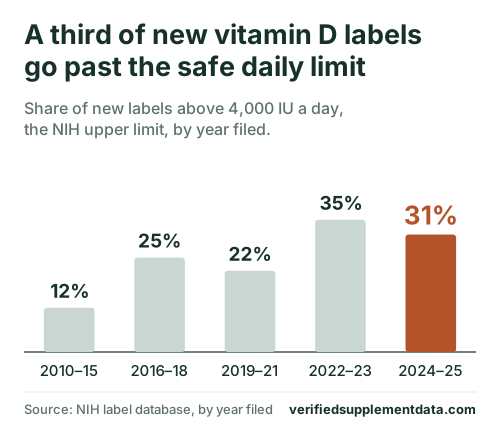
Brands mostly did not raise the dose of products they already sold. The climb comes from new products that start higher. In 2024 the Endocrine Society advised healthy adults under 75 not to take more than the recommended daily amount [6].
The B6 on Amazon is 8 times Europe’s safe limit, and has been for years
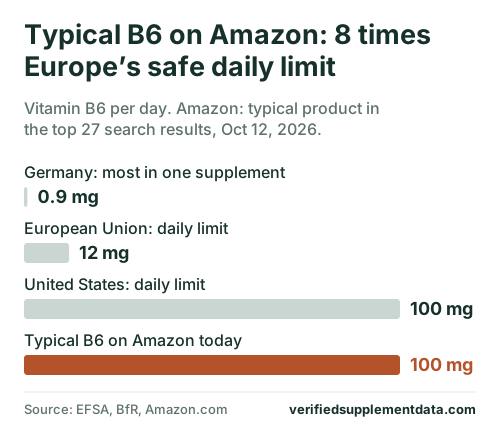
Europe lowered its safe daily limit for vitamin B6 to 12 mg in 2023 [7]. Germany now says one supplement should hold no more than 0.9 mg [8]. The US limit is still 100 mg. In the top 27 Amazon search results for vitamin B6, the typical product has 100 mg. 26 of 27 are over Europe’s limit.
This one is not new. In every period since 2010, 84% to 88% of B6 labels filed with the NIH were above 12 mg, and the typical label held 50 mg. B6 did not creep up. It started high and stayed there.
Too much B6 can damage nerves. Australia’s drug regulator has 250 reports of nerve damage tied to B6 products, 130 of them in 2025, and will make B6 above 50 mg a day pharmacist-only from June 2027 [9]. In the Netherlands, 79 of 238 reports of B6 nerve pain involved 12 mg a day or less [10]. B6 also hides in multivitamins, magnesium blends and energy drinks, so it adds up.
What Amazon shows first is even stronger
A label on file is not a sale. So on October 12, 2026 we also read the first 30 Amazon results for each search, skipping ads. Those are the bottles a shopper sees first, and they skew high: 41% of biotin results were 10,000 mcg or more, and 50% of vitamin D results were over 4,000 IU.
| Search | Typical dose | High doses |
|---|---|---|
| Biotin | 8,000 mcg | 12 of 29 at 10,000 mcg+ |
| Melatonin | 5 mg | 13 of 30 at 10 mg+ |
| Vitamin D3 | 4,000 IU | 15 of 30 over 4,000 IU |
| Vitamin B6 | 100 mg | 26 of 27 over 12 mg |
Zinc and magnesium did not climb. Many were already too high.
Not everything went up. Zinc and magnesium doses stayed flat. But about a quarter of zinc labels and half of magnesium labels have been over the upper limit the whole time. Vitamin B6, selenium, ashwagandha and creatine doses did not rise either.
| Nutrient (limit) | 2010–15 | 2016–18 | 2019–21 | 2022–23 | 2024–25 |
|---|---|---|---|---|---|
| Zinc (40 mg) | 33% | 25% | 34% | 26% | 26% |
| Magnesium (350 mg) | 54% | 54% | 51% | 52% | 50% |
Why it keeps happening: the FDA is not allowed to cap vitamin doses
In 1976, Congress passed a law that says the FDA “may not establish… maximum limits on the potency” of vitamins and minerals [2]. The NIH upper limits are advice. No rule makes a label stay under them. So nothing stops the next product from launching higher than the last. Other countries draw lower lines.
| US | Europe | Germany | Canada | |
|---|---|---|---|---|
| Vitamin B6 | 100 mg | 12 mg | 0.9 mg | Warning at 10 mg |
| Vitamin D | 4,000 IU | 4,000 IU | 800 IU | 2,500 IU |
| Biotin | None | None | Lab-test warning | 500 mcg in multis |
US and Europe: upper limits for food and supplements together. Germany: most in one supplement. Canada: most without a prescription, or the dose that needs a warning on the label. Sources [1], [7], [8], [11].
How to check your own bottle
- Ignore the front. Find the dose per serving on the Supplement Facts panel, then multiply by the servings per day.
- Compare that number with the US limits above. If you are over and no doctor told you to be, ask if you need that much.
- Add up every product you take. B6, vitamin D and zinc show up in multivitamins and blends.
- Taking biotin? Tell your doctor or lab before any blood test.
- Keep melatonin gummies away from kids. They look like candy.
You can look up any label in the NIH database.
How we did this
- We used the NIH Dietary Supplement Label Database [1], which holds 214,740 labels. We read the Supplement Facts panel on labels where the nutrient is the main ingredient: it is in the product name, or the label lists two active ingredients or fewer. Multivitamins are not included.
- Daily dose is the dose per serving times the most servings a day the label allows. If a label gives no servings per day, we counted one. Using one serving instead gives the same picture: biotin at 10,000 mcg or more went from 7% to 33%, vitamin D over 4,000 IU from 11% to 29%.
- Labels are grouped by the date they entered the NIH database. The newest label is dated September 25, 2025, so the last period is 2024–25.
- We checked each trend three ways: labels still on the market, brands that filed in both early and late years, and a split-half test. We only report a trend whose direction held every time. Early periods are smaller. The 95% ranges: biotin 4–21% in 2010–15 against 26–42% in 2024–25; vitamin D 8–18% against 23–40%; melatonin at 10 mg or more 5–20% against 21–33%.
- We dropped doses that are impossible for one serving and checked the most extreme labels by hand. Two had data-entry errors and were removed.
- Amazon: the first 30 non-ad results for “biotin supplement”, “melatonin”, “vitamin d3” and “vitamin b6” on October 12, 2026, assuming one serving a day. Kids’ products and listings with no readable dose were left out. Every product we read.
What this does not show
- It is not a safety test. A high dose is not proof of harm, and doctors sometimes prescribe high doses on purpose.
- The year is when the NIH filed the label, which is usually close to when it went on sale, but not always.
- Older labels that were pulled from the market are under-counted.
- FDA reports of supplement side effects overall have not gone up. We do not claim they have.
Use this report
Free to share and reuse with credit and a link to this page (CC BY 4.0). Download the data (CSV, with 95% ranges) · Amazon snapshot (CSV) · charts: summary, biotin, melatonin, vitamin D, B6.
Rose E. “Supplement doses keep climbing. The US sets no limit.” Verified Supplement Data, version 1.0, October 13, 2026. https://verifiedsupplementdata.com/research/supplement-dose-creep/. Data: doi:10.5281/zenodo.23336533
Archived dataset with a permanent DOI: 10.5281/zenodo.23336533 (Zenodo).
Reporters: we can run the same analysis on another supplement. Found an error? Email hello@verifiedsupplementdata.com. Changes are logged below and on our corrections page.
Questions
Are supplement doses really getting higher?
For some supplements, yes. Among biotin labels filed with the NIH in 2010–15, 9% called for 10,000 mcg a day or more. For labels filed in 2024–25 it was 34%. Melatonin and vitamin D went up too. Zinc and magnesium did not.
Is there a legal limit on vitamin doses in the US?
No. A 1976 federal law, now 21 U.S.C. 350, says the FDA may not set maximum limits on the potency of vitamins and minerals in supplements. The NIH publishes upper limits, but they are advice, not rules.
What is an upper limit?
It is the most of a nutrient a healthy adult can take every day, from food and supplements together, without likely harm. It is not a goal. Doctors sometimes prescribe more for a short time to treat a deficiency.
Why does biotin matter if it has no upper limit?
High-dose biotin can make some blood tests read wrong. The FDA says one patient taking high levels of biotin died after a heart test gave a falsely low result. If you take biotin, tell your doctor before any blood test.
Should I stop taking my supplement?
This report does not say any product is unsafe for you. If your dose is above the upper limit and no doctor told you to take that much, ask your doctor or pharmacist if you need it.
Sources
- NIH Office of Dietary Supplements. Dietary Supplement Label Database, and fact sheets for upper limits (vitamin D 4,000 IU; B6 100 mg; zinc 40 mg; supplemental magnesium 350 mg; biotin adequate intake 30 mcg).
- 21 U.S.C. § 350, Vitamins and minerals. Cornell Legal Information Institute.
- US FDA. Biotin interference with troponin lab tests; safety communication November 28, 2017, updated November 5, 2019.
- Lelak K et al. Pediatric melatonin ingestions, United States, 2012–2021. MMWR 2022;71(22). CDC.
- Cohen PA et al. Quantity of melatonin and CBD in melatonin gummies sold in the US. JAMA 2023;329(16):1401–1402. JAMA.
- Demay MB et al. Vitamin D for the prevention of disease: an Endocrine Society clinical practice guideline. J Clin Endocrinol Metab 2024;109(8):1907. Oxford Academic.
- EFSA NDA Panel. Tolerable upper intake level for vitamin B6. EFSA Journal 2023;21(5):e08006; EFSA upper intake levels summary.
- German Federal Institute for Risk Assessment (BfR). Maximum levels for vitamins and minerals in food supplements, opinions 006/2024–010/2024, February 22, 2024.
- Therapeutic Goods Administration, Australia. Notice of final decision, vitamin B6, November 25, 2025.
- Lareb, Netherlands Pharmacovigilance Centre. Nerve damage due to the use of nutritional supplements with vitamin B6, November 13, 2024.
- Health Canada. Multi-Vitamin/Mineral Supplements monograph, June 2026; Prescription Drug List notice on vitamin D, February 22, 2021.
Version history
- 1.0 · October 13, 2026. First published.